5 Unexpected Payment Trends That Could Take 2025 by Storm
Dmytro Spilka·4 min


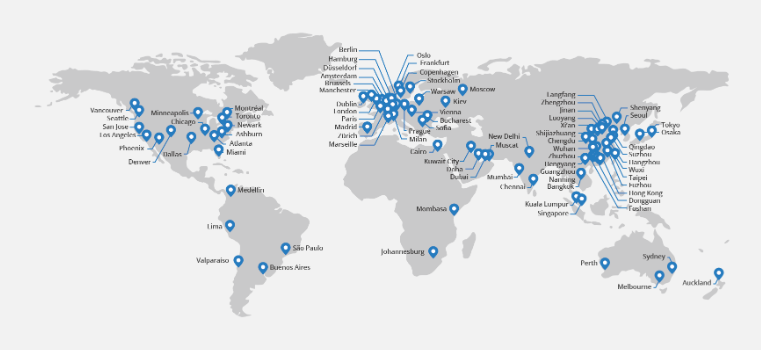 The company itself is a big proponent of net neutrality championing the decentralized model based on the IPFS protocol. They were embroiled in some controversy initially when they were blamed for optimizing content for controversial websites & malicious players. Fuel was added to the fire when they failed to drop such clients from their service. Finally after getting a lot of heat from the Press & being dubbed as "terrorists’ little helper" they decided to update their abuse reporting system to allow people to file complaints about material on their sites on which action could be taken. Dust seems to have settled down on this front after they banned one such racist website setting a precedent going forward.
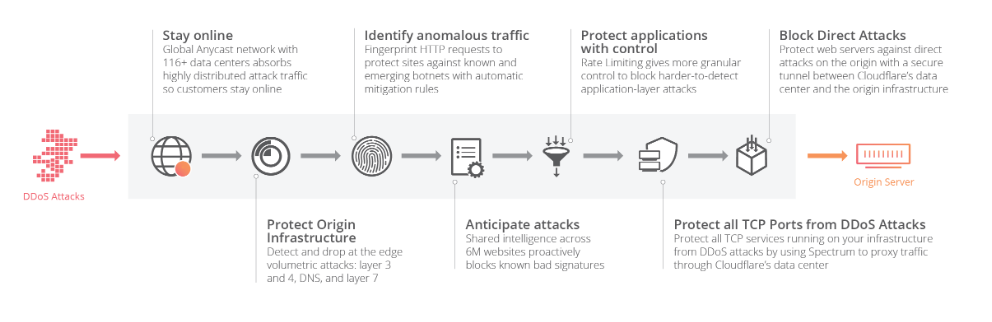 Simply put, CloudFlare claims to provide a fast, reliable & safe Cloud hosting service (or content delivery network) by integrating the emerging technologies - most notably the IPFS. It has recently announced the introduction of IPFS gateway which allows the creation of websites on distributed P2P technology. Before moving on to discussing IPFS in more detail, let's take a look at how CloudFlare prides itself to be a DDoS (Distributed Denial of Service) mitigation service & how it accomplishes this (figure above). DDoS is a basically a malicious attack on a server by flooding it with unwanted traffic. These computers are then infected with malware converting them into a bot which can be controlled remotely and used for further attacks. You might have seen this online when one of the website goes down. These kind of incidents are going to become more commonplace with the increasing number of networks going online, specially with billions of devices connecting under the umbrella of IoT.
 IPFS File storage network was originally launched on the Bitcoin Blockchain by Protocol Labs in 2014, but moved to Ethereum in 2016, citing better development support & innovative features. IPFS has been on a mission to decentralize the Web by providing support for distributed applications, content addressing & digital signatures.
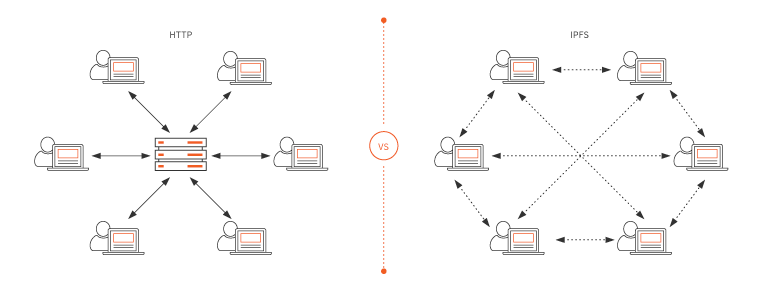
Conventionally, when we are accessing the Internet or the Web we always use HTTP:// before the site address that we are trying the access online. HTTP or the HyperText Transfer Protocol encompasses location-based address system. In this system the content stored at a location (server) is assigned an IP number like 192.68.10.152 which is mapped on to the name of the website like google.com. Therefore when you type google.com in your browser if fetches the content for you that is residing on the IP address assigned to the Google website. IPFS on the other hand uses a cryptographic hash on the address 'QmXnnyufdzAWL5CqZ2RnSNgPbvCc1ALT73s6epPrRnZ1X' exactly like the blockchain networks. The content with that hash address can be stored on multiple locations. That means if one of nodes goes down for some reason, the network will look for content on another node with the same hash value.
https://www.youtube.com/watch?v=8CMxDNuuAiQ
IPFS is laying the foundation of tomorrow's Web. Here are some of the reasons why IPFS beats the HTTP system hands down.
IPFS File storage network was originally launched on the Bitcoin Blockchain by Protocol Labs in 2014, but moved to Ethereum in 2016, citing better development support & innovative features. IPFS has been on a mission to decentralize the Web by providing support for distributed applications, content addressing & digital signatures.
Conventionally, when we are accessing the Internet or the Web we always use HTTP:// before the site address that we are trying the access online. HTTP or the HyperText Transfer Protocol encompasses location-based address system. In this system the content stored at a location (server) is assigned an IP number like 192.68.10.152 which is mapped on to the name of the website like google.com. Therefore when you type google.com in your browser if fetches the content for you that is residing on the IP address assigned to the Google website. IPFS on the other hand uses a cryptographic hash on the address 'QmXnnyufdzAWL5CqZ2RnSNgPbvCc1ALT73s6epPrRnZ1X' exactly like the blockchain networks. The content with that hash address can be stored on multiple locations. That means if one of nodes goes down for some reason, the network will look for content on another node with the same hash value.
https://www.youtube.com/watch?v=8CMxDNuuAiQ
IPFS is laying the foundation of tomorrow's Web. Here are some of the reasons why IPFS beats the HTTP system hands down.
Faisal is based in Canada with a background in Finance/Economics & Computers. He has been actively trading FOREX for the past 11 years. Faisal is also an active Stocks trader with a passion for everything Crypto. His enthusiasm & interest in learning new technologies has turned him into an avid Crypto/Blockchain & Fintech enthusiast. Currently working for a Mobile platform called Tradelike as the Senior Technical Analyst. His interest for writing has stayed with him all his life ever since started the first Internet magazine of Pakistan in 1998. He blogs regularly on Financial markets, trading strategies & Cryptocurrencies. Loves to travel.